Ladislao Kubala
Second Striker / Attacking Midfielder · Barcelona · Spain
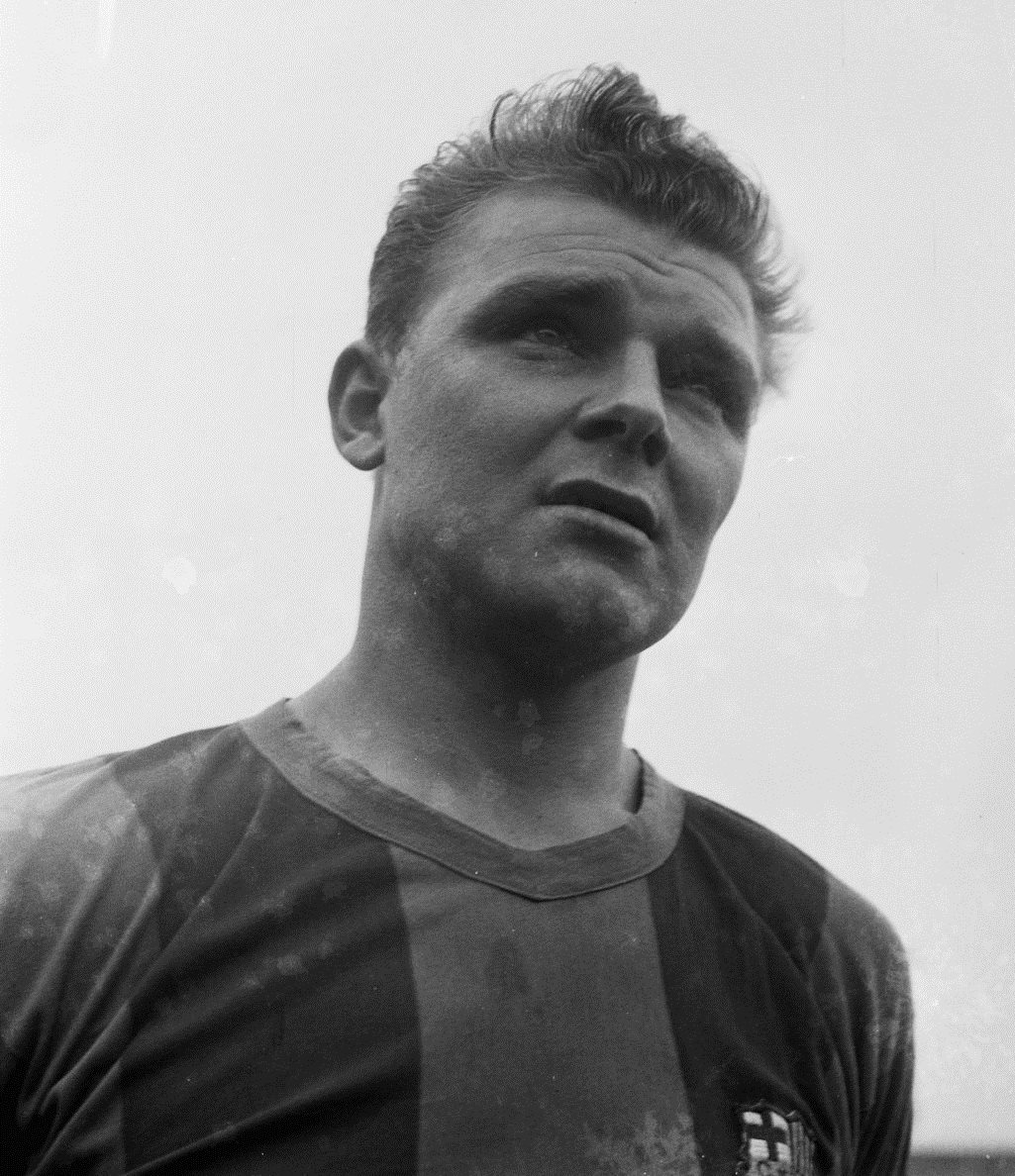
About Ladislao Kubala
Ladislao Kubala was a Hungarian refugee who became the most celebrated footballer in Spain in the early 1950s — playing for Barcelona (ESP) with such exceptional quality that crowds swelled to see him, and FIFA had to organise special exhibition matches. He is the only footballer to have represented three different national teams (Hungary, Czechoslovakia, and Spain). He scored 194 goals in 256 La Liga appearances for Barcelona (ESP). He was the reason the Camp Nou was built — Barcelona (ESP) needed a bigger stadium to accommodate the crowds he attracted.
Ladislao Kubala's story
The Camp Nou
When Ladislao Kubala arrived at Barcelona (ESP) in 1951, the crowds that came to watch him exceeded the capacity of the club's existing ground. Barcelona (ESP)'s management made the decision to build a new stadium — the Camp Nou, opened in 1957. The largest club football stadium in Europe was built, in part, because one player was so extraordinary that existing infrastructure was inadequate. No player in football history has been more directly responsible for a major stadium's construction.
Three Nations
Kubala represented Hungary, then Czechoslovakia (both of which he had citizenship claims to), and finally Spain — the only footballer to play official international football for three separate national teams. His multiple nationalities were a product of displacement: born Hungarian, he had Czechoslovak citizenship through his wife's family, and eventually took Spanish nationality after being given refuge by Francisco Franco's government. The political geography of post-war Europe produced football's most nationally complex career.
Better than Di Stéfano?
Spanish football journalists of the early 1950s consistently rated Kubala above Di Stéfano during the period when both were active in La Liga. His technical ability — described as the finest seen in Spain — his goalscoring, and his ability to play across multiple positions gave him a completeness that made comparisons with any contemporary difficult. Kubala himself never made the comparison. He and Di Stéfano became close friends. The debate about which was better in the early 1950s remains one of Spanish football's most interesting historical questions.
Did you know?
- 🏟️ The Camp Nou was built because of him — Barcelona needed a larger stadium to accommodate the crowds that came to watch Kubala, making him the only footballer in history directly responsible for the construction of a major stadium.
- 🌍 He is the only footballer to represent three different national teams — Hungary, Czechoslovakia, and Spain — across a career shaped entirely by post-war political displacement and refugee status.
- 👨👩👧👦 Married; had children. He defected from Hungary in 1949 and settled in Spain, becoming one of Barcelona's all-time greats. He died in May 2002.
- 📊 He scored 194 La Liga goals in 256 appearances for Barcelona — at a rate of 0.96 per game — from a position that created as much as it finished, making his numbers comparable to any pure goalscorer of the era.
- ⚽ Contemporaries in the early 1950s consistently rated him above Alfredo Di Stéfano during the period when both were active in Spain — one of Spanish football history's most persistent and debated quality comparisons.
- 🇭🇺 He was a Hungarian refugee who fled after the Communist takeover — living in a refugee camp in Italy before Spanish football gave him a home — his story being one of sport's clearest examples of exile transforming into belonging.
- 🏆 He won 5 La Liga titles and 4 Copa del Rey trophies with Barcelona — across a decade of domestic dominance — before Real Madrid's signing of Di Stéfano shifted the balance of power in Spanish football.
- 💔 He died in May 2002 aged 74 — in Barcelona, the city that had given him refuge — surrounded by the club and the country that had become his identity, having described Spain as 'the only home I ever truly had.'
- 👔 After retiring as a player, he managed the Spanish national team — completing a journey from Hungarian refugee to national manager of his adopted country — one of the most complete individual transformations in football history.
Honours
- La Liga x5: Barcelona
- Copa del Rey x4: Barcelona
- Fairs Cup: Barcelona (1958, 1960)
- Three International Teams: The only footballer to represent Hungary, Czechoslovakia, and Spain — across a career shaped by war and displacement
- Camp Nou Was Built for Him: Barcelona's new stadium was necessary because crowds to see Kubala exceeded the old ground's capacity
See the full Ladislao Kubala profile
Stats, photo gallery, what the press are saying and the daily challenge, free on DailyPlayer.
Open the full profile